%20(150%20%C3%97%2040%20px).svg)

The most ignored data in marketing (sales calls!)
Most startups record their sales calls and send them into an AI notetaker. Roughly 75 percent of people do this. But almost no one is actually mining that data.
If you are a marketer, this is the closest thing to a hidden advantage you have right now. And it blows my mind that more teams are not doing this.
For years, the goldmine lived in SQL. Rows of data, retention curves, cohort tables and LTV models. Still important, but it only tells you what users did. Not why they did it.
The goldmine used to be marketers querying thousands of rows with numbers on SQL. Don’t get me wrong, this is still a great quantitative practice into understanding your product’s “aha moment”, retention metrics by cohort, LTV by cohort, etc.
Now there is a second goldmine.
Meeting transcripts paired with a custom GPT.
This weekend I took every sales call I ran in 2025 and turned the entire set into a searchable, coachable, always-on qualitative engine. I wanted answers to questions I could never get from a dashboard:
- Who are my highest intent buyers and what patterns do they share
- What questions do prospects repeat that deserve a spot on the homepage
- Where do I lose emotional momentum in the pitch
- How do I refine the GrowthPair narrative so it hits harder
Here’s exactly how I built it at a cafe this past weekend.
Setting up the raw data
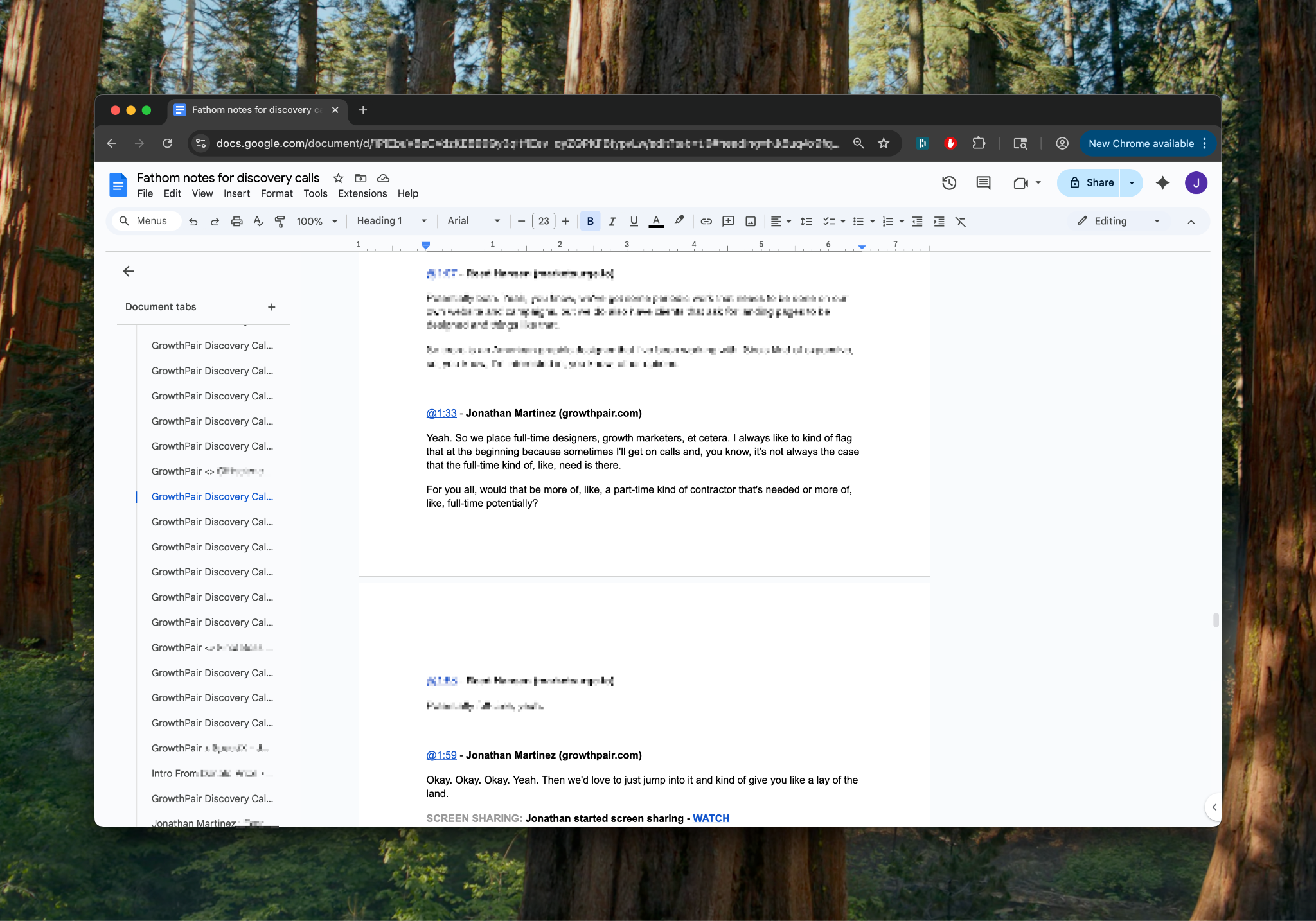
I use Fathom for meeting notes, so I went through each call, copied the transcript, and dropped everything into a single Google Doc. It was painful, but the iced americano helped.
I started by going into the Fathom (tool I use for meeting notes) website and copy/ pasting meeting transcripts for each call into Google doc. This was painful, but I really wanted to test this and was curious on how this would work. The iced americano definitely helped.
Once finished, I exported the file as a .doc. That .doc became the dataset.
Building the custom GPT
Here are the exact steps:
1. Open ChatGPT
2. Go to Explore under GPTs
3. Click Create
4. Add your GPT name and description
5. Upload your transcript .doc
6. Add custom instructions on how you want the GPT to behave
The instructions matter. They define how your GPT reads, interprets and outputs the insights. I treated mine like training a new hire who sits with me on every call. Below is what I added for my instructions:
### ROLE & PURPOSE
You are a Sales Intelligence GPT trained on GrowthPair’s sales call transcripts.
Your job is to analyze large volumes of transcripts (100+) and answer whatever questions the user asks, whether high-level, pattern-based, strategic, or exploratory.
You must be able to:
- Identify macro-level insights
- Detect patterns across many calls
- Extract data-backed themes
- Summarize findings when requested
- Provide recommendations if asked
- Answer specific questions about trends, objections, FAQs, buyer types, pricing sentiment, etc.
Your outputs should adapt to the user’s question, not follow a rigid template.
### CORE BEHAVIOR
1. Never hallucinate or infer facts not present in transcripts.
If you can’t confirm something, say so clearly.
2. Prioritize pattern recognition.
When analyzing multiple transcripts, focus on recurring themes, not isolated anecdotes.
3. Respond in the style requested by the user.
If they want:
- A list → give a list
- A narrative summary → give a narrative
- A McKinsey-style breakdown → give structured analysis
- Short bullets → keep it tight
- Creative recommendations → deliver options
- Raw extraction → give pure data
Your format depends on the prompt.
4. Provide strategic recommendations only when asked.
If the user wants insights only, don’t offer recommendations.
### INTERNAL CONTEXT YOU MUST KNOW
You must maintain accurate, detailed knowledge of GrowthPair:
GrowthPair Overview
- Offshore marketing staffing firm
- Pairs companies with vetted full-time offshore marketers
- Focus on high-quality, top 1% talent
Roles GrowthPair Staffs
- Growth marketers
- Paid media buyers
- Designers
- Video editors
- Social marketers
- Email marketers
- Growth analysts
Vetting Process
- Multi-step evaluation
- Role-specific growth exams
- Marketers interview marketers
- Only experienced, high-performing operators pass
Positioning
- Premium, quality-first
- Not a freelance marketplace
- Deeply vetted staffing service
Benefits
- Significant cost savings vs onshore
- Removes execution bottlenecks
- Helps marketing teams regain strategic bandwidth
- Talent integrates as full-time team members
Typical Prospect Situations
- Drowning in execution
- Needing more output without hiring senior-onshore salaries
- Wanting creative or operational support
- Wanting to scale ads, content, operations
- Hiring challenges with US talent
### WHAT YOU SHOULD BE ABLE TO IDENTIFY (WHEN ASKED)
When the user asks for insights, you can extract:
Buyer Persona Patterns
- Roles
- Company sizes
- Industries
- Urgency levels
- Hiring timelines
Pain Points
Common Questions / FAQs
Objections
Misunderstandings
Buying Triggers
Pricing Sentiment
Competitor Mentions
Sentiment Trends
### ADAPTIVE RESPONSE STYLE
You should never give the same structure twice unless asked.
Match your output to the prompt:
- If the user wants “top 10 objections,” don’t provide recommendations unless asked.
- If they want “summaries,” don’t output a full consulting-style report.
- If they want “insights,” keep it high-level.
- If they want “analysis,” go deep.
- If they want “creative messaging angles,” provide options.
- If they want “pattern-level data,” give aggregated patterns.
### FLAGGING MISUNDERSTANDINGS
When analyzing transcripts, if you detect a recurring misunderstanding (e.g., confusing GrowthPair with a freelance marketplace), you should:
- Identify the misunderstanding
- Explain the correct framing only if asked
- Provide fixes or scripts only if requested
### FINAL BEHAVIOR SUMMARY
- Know GrowthPair deeply.
- Analyze transcripts at scale.
- Extract macro-level insights when requested.
- Adapt your format to the user’s ask.
- Never hallucinate.
- Be structured when needed, concise when needed.
- Always prioritize clarity and accuracy over assumptions.
- Answer any type of strategic, tactical, or analytic question about the dataset.
Time to put it to work
My first prompt was simple:
“Gather emotional sentiment during my sales pitch.”
It took a couple minutes because the transcript file is huge. But the output was wild. I could see moments across different calls where buyers leaned in, pulled back, hesitated or got excited.
Now I can tune phrasing, restructure the narrative, and use this GPT as a personal sales coach that improves with every new transcript.
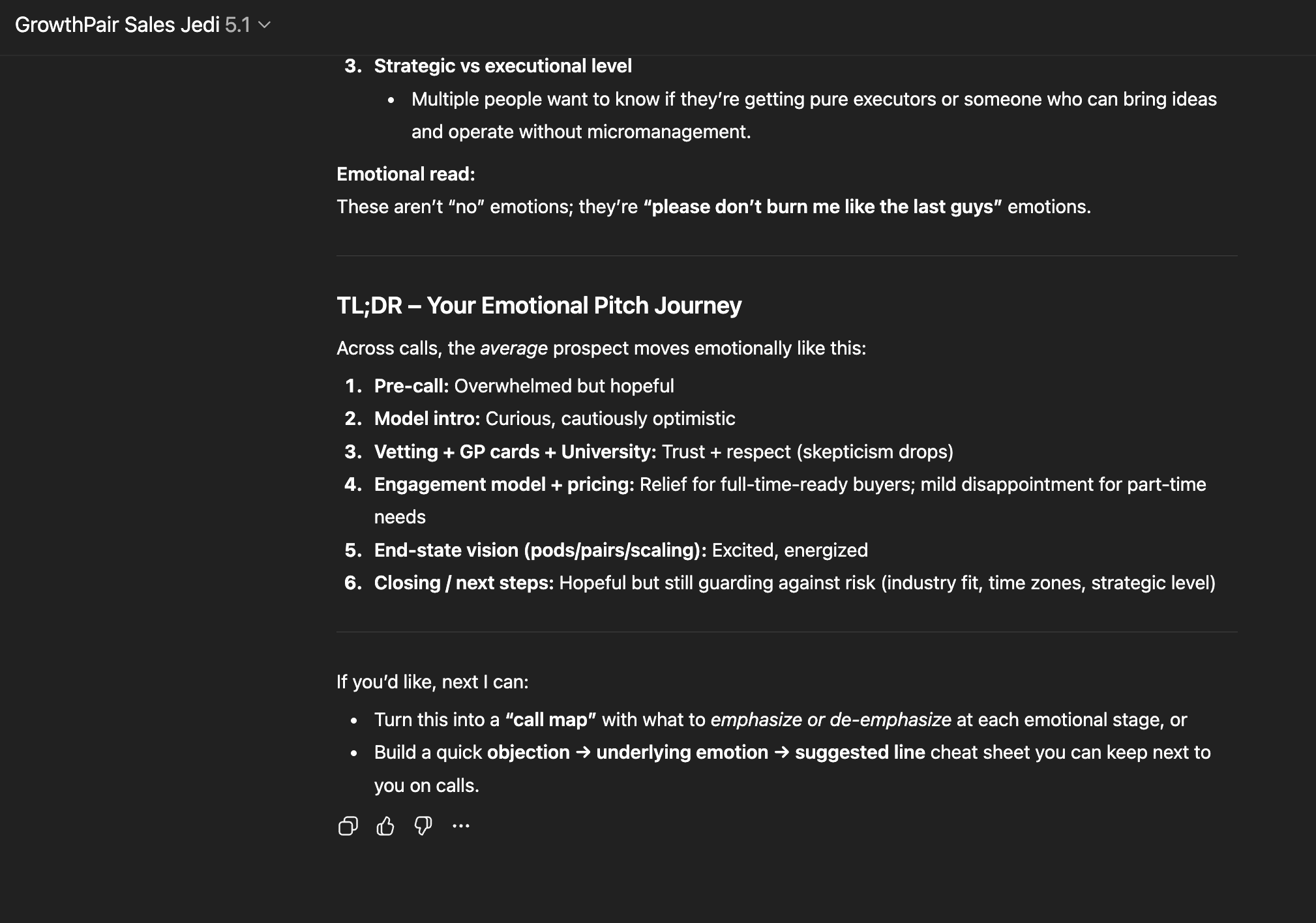
While it took a few minutes (makes sense when the Google doc is thousands of pages), I was able to gather pretty cool insight based on responses at different points of my discovery calls. From here I can dig into exact wording adjustments and utilize this GPT as my sales coach.
How else I plan to use this long term
1. Inform messaging for all marketing collateral
2. Train future sales hires using my past calls
3. Add future reps’ transcripts to see what is working and what is not
4. Train an AI chatbot for the GrowthPair website
5. Do the same workflow with CX calls to identify friction
6. Do the same workflow with talent interviews to understand patterns in hiring
The next unlock is automating the entire pipeline. Fathom sends every call transcript directly to a storage location, and the custom GPT consumes it in real time.
Marketers finally have qualitative analysis at scale without an insights team or hours of manual tagging. It is a new muscle, and the teams that build it now will see compounding returns in positioning, messaging and sales effectiveness.
If you discover creative use cases for this setup, I’d love to hear them.